Silver dollar value: how to tell what your US silver dollar is worth
A US silver dollar is a one-dollar coin struck in silver, mainly the Morgan dollar (1878–1904 and 1921) and the Peace dollar (1921–1928 and 1934–1935), both 90% silver. Each one holds about 0.77 troy ounce of pure silver, so even a worn common date is worth its silver value, which is many times its face value. A silver dollar is worth much more when it has a scarce date and mint mark, such as the 1893-S Morgan or the 1928 Peace, or when it is in high Mint State condition.
Morgan and Peace dollar specifications
| Country | United States |
|---|---|
| Years | Morgan: 1878–1904 and 1921. Peace: 1921–1928 and 1934–1935 |
| Composition | 90% silver, 10% copper |
| Weight | 26.73 g |
| Pure silver | About 0.7734 troy oz (24.06 g) |
| Diameter | 38.1 mm |
| Edge | Reeded |
| Designers | Morgan: George T. Morgan. Peace: Anthony de Francisci |
| Mints | Morgan: Philadelphia, New Orleans (O), San Francisco (S), Carson City (CC), Denver (D, 1921 only). Peace: Philadelphia, Denver (D), San Francisco (S) |
Which US dollars are silver
The United States struck silver dollars from 1794 to 1935. After a long pause, it made 40% silver dollars for collectors from 1971 to 1976, and since 2021 it has sold .999 silver Morgan and Peace dollars as collector coins. Dollar coins made for everyday use since 1971 contain no silver.
| Series | Years | Silver | Mints |
|---|---|---|---|
| Flowing Hair | 1794–1795 | Silver | Philadelphia |
| Draped Bust | 1795–1803 | Silver | Philadelphia |
| Seated Liberty | 1840–1873 | 90% | Philadelphia, New Orleans, San Francisco, Carson City |
| Trade dollar | 1873–1885 | 90% (27.22 g, heavier than a regular dollar) | Philadelphia, San Francisco, Carson City |
| Morgan | 1878–1904, 1921 | 90% | Philadelphia, New Orleans, San Francisco, Carson City, Denver (1921) |
| Peace | 1921–1928, 1934–1935 | 90% | Philadelphia, Denver, San Francisco |
| Eisenhower, collector versions | 1971–1974, 1776–1976 | 40% | San Francisco only |
| Morgan and Peace, modern collector coins | 2021 onward | 99.9% | Several, including privy-marked versions |
| Eisenhower (circulating), Susan B. Anthony, Sacagawea, Presidential and later | 1971 onward | None | Philadelphia, Denver, San Francisco |
Almost every silver dollar you will find in a drawer, an inheritance or a dealer’s tray is a Morgan or a Peace dollar. The rest of this guide focuses on them, with a section on silver Eisenhower dollars.
How to identify your silver dollar
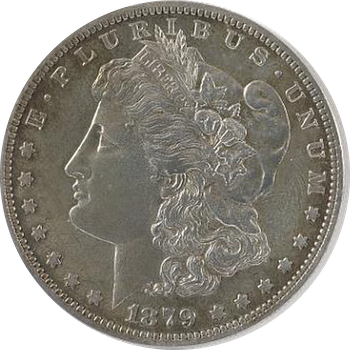
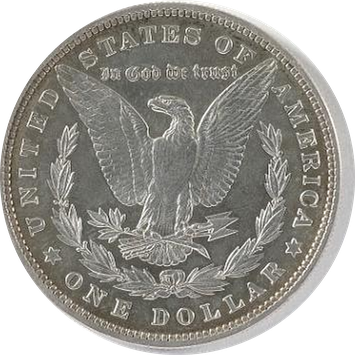
Morgan dollar. Liberty faces left, with a cap and a band reading LIBERTY, and the date below. The reverse shows an eagle with wings spread, holding arrows and an olive branch, inside a wreath. The mint mark, if there is one, is on the reverse, just below the wreath and above the letters DO of DOLLAR. No mint mark means Philadelphia.
Peace dollar. Liberty faces left wearing a crown of light rays, and the word PEACE is on the reverse, under an eagle perched on a rock. The mint mark is on the reverse, at the lower left, below the word ONE and near the tip of the eagle’s wing. No mint mark means Philadelphia. The 1921 Peace dollar was struck in high relief, with a design that stands out more from the surface; it is the only year with that look.
Silver Eisenhower dollar. The large dollar with Dwight D. Eisenhower on the front. Only San Francisco collector coins are silver, and the S mint mark is on the front, above the date. Because San Francisco also struck clad coins, weigh it: a 40% silver Ike weighs 24.59 g and a clad one 22.68 g. On the edge, a clad Ike shows a brown copper core between the outer layers.
Trade dollar. Liberty sits facing left on a bale of goods, and the reverse says TRADE DOLLAR and 420 GRAINS, 900 FINE. It was made to compete with Mexican silver coins in East Asian trade, and many carry small Chinese merchant stamps called chopmarks.
Silver dollar key dates and mintages
Most Morgan and Peace dollars were made by the millions. These issues stand out because few were made, few survived, or few exist in top condition.
| Coin | Mint | Mintage | Why it matters |
|---|---|---|---|
| 1893-S Morgan | San Francisco | 100,000 | The hardest Morgan dollar to find in Mint State |
| 1889-CC Morgan | Carson City | 350,000 | An estimated 93% to 95% were melted under the 1918 Pittman Act |
| 1895 Morgan | Philadelphia | 880 proofs | Mint records list 12,000 circulation strikes, but the known coins are believed to be proofs |
| 1921 Peace, high relief | Philadelphia | 1,006,473 | One-year high relief design, struck in the last days of 1921 |
| 1928 Peace | Philadelphia | 360,649 | The lowest mintage Peace dollar, always considered a key date |
| 1934-S Peace | San Francisco | 1,011,000 | The key Peace dollar in Mint State |
Mintages from PCGS CoinFacts (see Sources). Full year-by-year mintage tables are in our Morgan and Peace dollar guides.
The Pittman Act of 1918 authorized the melting of millions of silver dollars, mostly Morgans. That is why some dates with large original mintages are scarce today, and why mintage alone does not tell you how rare a date is.
Silver dollar varieties and errors
Silver dollars were struck from many working dies, and small differences between them are collected as varieties. Morgan and Peace dollar varieties are catalogued by VAM number, and some, such as the 1934-S Peace with a doubled tiara (VAM-3), are recognized by grading services. Errors such as off-center strikes, clipped planchets and strikes on the wrong metal also exist but are uncommon. A suspected variety or error is worth checking with a reference book or a grading service before you sell.
What affects a silver dollar’s value
Silver content. A Morgan or Peace dollar holds about 0.7734 troy ounce of pure silver. Multiply that by today’s silver price to get the floor of its value. A 40% silver Ike holds about 0.316 troy ounce.
Date and mint mark. The same design can be common in one year and scarce in another, and the mint mark often makes the difference. Carson City (CC) coins attract extra demand from collectors.
Condition. Value rises steeply with grade. On a Morgan, look first at the hair above Liberty’s ear and at the eagle’s breast; on a Peace dollar, at Liberty’s hair and the eagle’s wing feathers. These high points show wear first. Uncirculated coins keep their original mint luster.
Surfaces. Cleaning, polishing, scratches and rim dings lower value. Some Morgan dollars have mirror-like fields, called prooflike, which collectors pay more for. Natural toning can add or subtract value depending on how attractive it is.
Authenticity. Counterfeit silver dollars are common, especially key dates and Carson City coins. A wrong weight, a soft or mushy design, or a mint mark that looks added are warning signs. For valuable dates, buy coins certified by a recognized grading service.
We do not publish price tables, because silver prices and the coin market change every day. To estimate what a specific coin is worth, compare recent sales of the same date, mint mark and grade, or ask a reputable dealer.